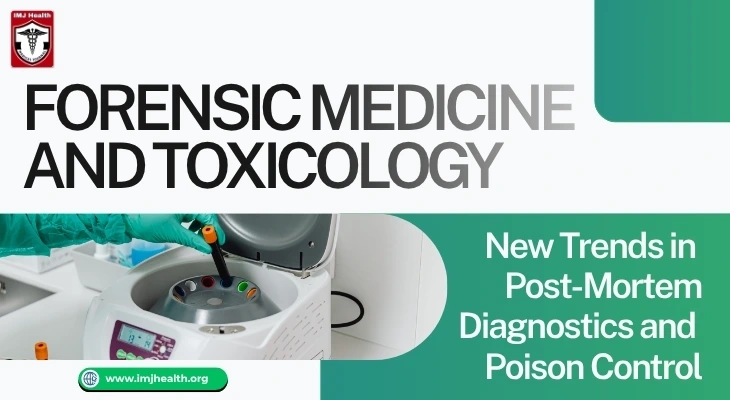
Forensic medicine and toxicology play a crucial role in modern healthcare, law enforcement, and public safety by helping determine causes of death, investigate suspicious circumstances, identify toxic exposures, and support legal decision-making. As medical science advances and criminal investigations become increasingly complex, forensic medicine is evolving beyond traditional autopsy methods toward more sophisticated diagnostic technologies and precision toxicology.
In today's healthcare and legal environments, forensic specialists are expected to provide highly accurate, scientifically validated evidence that supports criminal justice, public health surveillance, workplace safety, and poison prevention. At the same time, rising exposure to pharmaceuticals, chemicals, synthetic substances, environmental toxins, and accidental poisoning cases is increasing demand for more advanced toxicology systems.
In 2026, forensic medicine and toxicology are undergoing rapid transformation through digital autopsy technologies, artificial intelligence (AI), molecular pathology, advanced imaging systems, genetic analysis, biomarker discovery, and modern poison control strategies. These innovations are helping specialists improve diagnostic accuracy, identify causes of death more efficiently, and strengthen poisoning prevention and treatment efforts. For broader context on AI's role in healthcare, see The Role of Artificial Intelligence in Medical Research.
Among the most important developments are innovations in post-mortem diagnostics and poison control systems. These advances are improving forensic investigations, reducing diagnostic uncertainty, and enhancing emergency toxicology management.
This blog explores major developments in forensic medicine and toxicology in 2026, focusing on new trends in post-mortem diagnostics and poison control and how these innovations are shaping the future of forensic science and public health.
Understanding Forensic Medicine and Toxicology
Forensic medicine applies medical science to legal investigations.
Specialists help determine: Cause of death, Injury patterns, Time of death, Evidence of trauma, and Medical factors in criminal cases.
Toxicology focuses on the effects of chemicals, drugs, poisons, and toxins on the human body.
Forensic toxicologists analyze substances involved in: Poisoning cases, Drug overdoses, Environmental exposures, Workplace toxicity, and Criminal investigations.
These specialties play a major role in healthcare, legal systems, and public safety.
Post-Mortem Diagnostics in 2026
Traditional autopsies remain important, but modern forensic medicine increasingly uses advanced technologies to improve diagnostic precision.
Post-mortem diagnostics are becoming more accurate, less invasive, and increasingly data-driven.
Virtual Autopsy (Virtopsy)
One of the biggest innovations in forensic medicine is virtual autopsy.
Also known as virtopsy, this approach uses imaging technologies instead of—or alongside—traditional dissection.
Common technologies include: CT scans, MRI imaging, 3D reconstruction, and Digital body mapping.
Benefits include: Less invasive examination, Improved anatomical visualization, Better evidence preservation, and Faster forensic analysis.
Virtual autopsies are particularly useful in trauma cases and culturally sensitive situations where traditional autopsy may be limited.
AI-Assisted Post-Mortem Analysis
Artificial intelligence is increasingly supporting forensic diagnostics.
AI systems can help analyze: Injury patterns, Organ abnormalities, Tissue damage, and Imaging findings.
This improves diagnostic consistency and reduces human error.
AI also assists in identifying subtle forensic clues that may otherwise be overlooked. For insights into AI diagnostics, see The Black Box of AI Diagnostics and the Problem of Liability.

Molecular Autopsy and Genetic Testing
Molecular autopsy is becoming increasingly important.
Genetic testing can help identify inherited conditions that may contribute to unexplained deaths.
Applications include: Sudden cardiac death investigations, Genetic disorders, Metabolic abnormalities, and Drug metabolism differences.
This approach helps improve both forensic conclusions and family risk assessment.
Biomarkers in Post-Mortem Diagnosis
Biomarker research is improving forensic accuracy.
Scientists increasingly use biological markers to estimate: Time of death, Organ damage, Drug exposure, and Disease-related mortality.
Biomarkers help reduce uncertainty in difficult forensic cases.
Advanced Toxicological Testing
Toxicology testing has become faster and more sensitive.
Modern laboratories can identify: Prescription medications, Illicit substances, Environmental toxins, Heavy metals, and Chemical poison exposure.
Improved analytical precision strengthens forensic investigations.
Poison Control in 2026
Poisoning remains a major public health concern.
Poison exposures may involve: Household chemicals, Medications, Pesticides, Industrial toxins, Alcohol poisoning, and Drug overdoses.
Modern poison control systems increasingly emphasize rapid response and prevention.
Smart Poison Control Systems
Digital technologies are improving poison management.
Modern systems can support: Real-time poisoning guidance, Risk assessment, Emergency recommendations, and Exposure tracking.
Poison control centers increasingly use digital databases for faster decision-making.
AI in Poison Detection
Artificial intelligence is improving toxicology risk assessment.
AI systems analyze: Exposure history, Symptom patterns, Chemical toxicity databases, and Drug interaction risks.
This helps emergency teams identify poisoning risks earlier.
Rapid Toxicology Screening
Modern toxicology testing delivers faster results.
Rapid screening supports: Emergency treatment decisions, Overdose management, Poison identification, and Drug interaction detection.
Faster diagnosis improves survival outcomes.
Drug Overdose Management
Medication overdoses remain a major concern globally.
Emergency medicine increasingly uses precision toxicology to guide treatment.
Advanced monitoring helps clinicians manage: Opioid overdose, Polypharmacy toxicity, Sedative poisoning, and Accidental medication exposure. These approaches connect to Innovations in Clinical Research in emergency medicine.
Environmental and Occupational Toxicology
Environmental toxins are receiving growing attention.
Common risks include exposure to: Heavy metals, Industrial chemicals, Air pollutants, and Contaminated water.
Forensic toxicology increasingly supports workplace safety and environmental investigations.
Forensic Toxicology and Public Health
Forensic toxicology increasingly contributes to public health surveillance.
Data from poisoning cases helps identify: Drug abuse trends, Chemical exposure risks, Public safety concerns, and Emerging toxic substances.
This information supports prevention strategies and policy decisions. These public health connections are also discussed in Top 10 Public Health Challenges in 2025.
Challenges Facing Forensic Medicine and Toxicology
Despite major advancements, challenges remain.
Complex Toxic Exposures – New synthetic chemicals and drugs continue emerging. This complicates toxicology analysis.
Resource Limitations – Advanced forensic technologies may remain expensive or inaccessible in some regions.
Legal and Ethical Concerns – Forensic evidence must maintain scientific reliability and legal validity. Maintaining accuracy remains essential.
The Future of Forensic Medicine and Toxicology Beyond 2026
Future forensic medicine is expected to become increasingly digital and predictive.
Emerging innovations may include: Fully digital autopsies, AI-assisted forensic reconstruction, Smarter poison prediction systems, Advanced molecular diagnostics, and Real-time toxicology monitoring.
Researchers increasingly aim to improve accuracy while reducing diagnostic delays. For those considering doctoral research in this area, Top 10 Pharmaceutical Research Topics for PhD offers guidance on selecting impactful research directions.
Conclusion
Forensic medicine and toxicology in 2026 are rapidly evolving through advances in post-mortem diagnostics and poison control systems. Technologies such as virtual autopsy, AI-assisted analysis, molecular pathology, biomarker research, and rapid toxicology testing are improving diagnostic precision and strengthening forensic investigations.
At the same time, smarter poison control systems and advanced toxicology tools are enhancing emergency response, poisoning prevention, and public health surveillance. While challenges involving new toxins, accessibility, and legal reliability remain, the future of forensic medicine is increasingly focused on precision, speed, and scientific accuracy.
As medical science and digital technologies continue advancing, forensic medicine and toxicology will remain essential for improving justice, protecting public health, and supporting safer communities through more effective diagnostic and poison management strategies.