Global health systems continue facing unprecedented challenges as infectious diseases, emerging pathogens, climate-related health risks, healthcare inequality, and population mobility reshape public health priorities worldwide. While scientific advances have significantly improved disease prevention, diagnostics, and treatment, recent public health crises have demonstrated that no healthcare system is fully immune to large-scale outbreaks or rapidly evolving global health threats.
Pandemics and widespread infectious disease emergencies have highlighted the importance of preparedness, international collaboration, strong surveillance systems, equitable healthcare access, and rapid vaccine development. Governments, healthcare institutions, scientists, and global organizations increasingly recognize that prevention and early response are essential for protecting populations and reducing social and economic disruption.
In 2026, global health strategies are becoming increasingly proactive, technology-driven, and data-informed. Advances in artificial intelligence (AI), genomic surveillance, digital epidemiology, vaccine innovation, predictive analytics, and international public health coordination are helping healthcare systems strengthen resilience against future outbreaks. For broader context on vaccine development, see The Future of Vaccines: What's Next in Immunization.
Among the most urgent priorities are pandemic preparedness, vaccination systems, and disease surveillance. These areas are central to identifying health threats early, preventing disease spread, improving healthcare response, and protecting vulnerable populations.
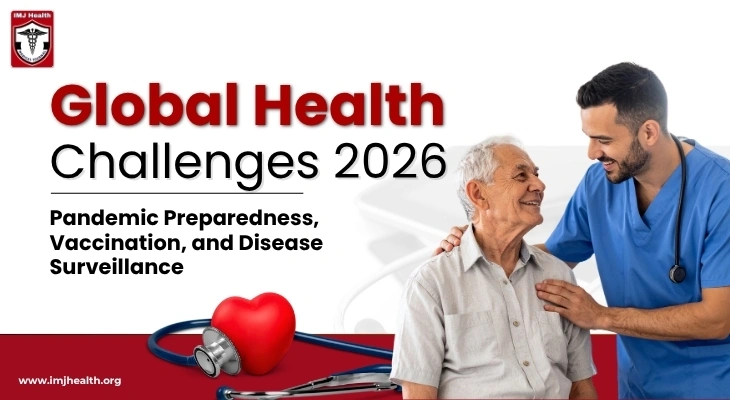
This blog explores major global health challenges in 2026, focusing on pandemic preparedness, vaccination, and disease surveillance and how these efforts are shaping the future of public health resilience.
Understanding Global Health Challenges
Global health refers to health issues that affect populations across countries and regions.
Major health challenges increasingly include: Infectious disease outbreaks, Chronic disease burden, Healthcare inequality, Climate-related health risks, Antimicrobial resistance, Aging populations, and Mental health concerns.
Because diseases can spread rapidly across borders, international cooperation remains essential. These challenges are discussed in detail in Top 10 Public Health Challenges in 2025.
Pandemic Preparedness in 2026
Pandemic preparedness refers to the ability of healthcare systems and governments to anticipate, detect, and respond to widespread disease outbreaks.
Preparedness has become a major healthcare priority.
Early Detection Systems
Rapid outbreak detection remains essential.
Modern preparedness increasingly depends on: Real-time surveillance, Genomic monitoring, Digital epidemiology, and International reporting systems.
Early identification helps reduce disease spread and improve response speed.
Healthcare System Readiness
Healthcare systems increasingly focus on preparedness strategies such as: Emergency response planning, Hospital surge capacity, Medical supply preparedness, and Workforce training.
Flexible healthcare systems improve resilience during emergencies.
AI and Predictive Disease Modeling
Artificial intelligence is becoming increasingly important in pandemic preparedness.
AI systems help analyze: Disease transmission patterns, Travel trends, Environmental risks, and Population movement.
Predictive analytics may help identify outbreaks earlier. For insights into AI diagnostics, see The Black Box of AI Diagnostics and the Problem of Liability.
Global Collaboration
International cooperation remains critical.
Organizations increasingly share: Disease surveillance data, Genomic findings, Research updates, and Treatment guidelines.
Cross-border coordination improves outbreak response.

Vaccination in Global Health
Vaccination remains one of the most effective public health interventions.
Immunization programs continue preventing millions of illnesses worldwide.
Advances in Vaccine Development
Modern vaccine technologies continue evolving rapidly.
Innovations include: mRNA vaccine platforms, Faster development systems, Personalized vaccines, and Broad-spectrum infectious disease protection.
These advances may improve responses to future outbreaks.
Vaccine Equity and Access
Global access remains a major challenge.
Some regions continue facing barriers such as: Limited healthcare infrastructure, Supply shortages, Economic inequality, and Distribution challenges.
Improving equitable access remains a major public health goal.
Combating Vaccine Hesitancy
Public trust plays a major role in vaccination success.
Healthcare systems increasingly focus on: Public education, Transparent communication, Community engagement, and Evidence-based information sharing.
Addressing misinformation remains important.
Adult and Preventive Vaccination
Vaccination efforts increasingly extend beyond childhood immunization.
Preventive vaccines may support: Older adult health, Chronic disease protection, and Seasonal illness prevention.
Lifelong vaccination strategies continue expanding.
Disease Surveillance in 2026
Disease surveillance involves monitoring health events to detect outbreaks and identify trends.
Modern surveillance systems are becoming increasingly sophisticated.
Genomic Surveillance
Genome sequencing helps scientists identify: New pathogen strains, Viral mutations, Resistance patterns, and Transmission pathways.
Genomic surveillance improves public health preparedness. For related insights on antimicrobial resistance, see Antibiotic Resistance and New Treatment Approaches.
Digital Epidemiology
Digital technologies increasingly support health monitoring.
Data sources may include: Health records, Mobility patterns, Search trends, and Environmental monitoring.
Digital epidemiology helps detect risks faster.
Wastewater Surveillance
Some health systems increasingly use wastewater monitoring.
This may help identify: Infection trends, Community disease spread, and Emerging outbreaks.
Such systems may provide early warning signals.
Wearable Health Monitoring
Wearable devices may contribute to surveillance through monitoring: Temperature changes, Respiratory patterns, and Physiological stress signals.
Researchers continue exploring population-level applications. For related insights on wearable technology, see Wearable Health Technology and Remote Patient Monitoring.
Emerging Health Threats
Global health systems continue preparing for emerging risks.
- Antimicrobial Resistance – Drug-resistant infections remain a growing concern.
- Climate Change and Disease Spread – Changing climates may influence: Vector-borne disease expansion, Air quality issues, and Heat-related illness.
- Zoonotic Disease Risks – Animal-to-human disease transmission remains a major public health focus. Early surveillance helps reduce outbreak potential.
Challenges Facing Global Health Systems
Despite major advances, important challenges remain.
- Healthcare Inequality – Access to healthcare remains uneven globally.
- Data Privacy and Ethics – Digital surveillance systems must balance health protection with privacy concerns.
- Public Trust – Health communication remains essential during crises.
- Funding and Infrastructure – Preparedness requires long-term investment.
The Future of Global Health Beyond 2026
Future public health systems are expected to become increasingly predictive and collaborative.
Expected developments include: AI-powered outbreak forecasting, Faster vaccine development, Personalized public health interventions, Smarter global surveillance networks, and Better emergency preparedness systems.
Researchers increasingly aim to prevent pandemics before widespread transmission occurs. For those considering doctoral research in this area, Top 10 Pharmaceutical Research Topics for PhD offers guidance on selecting impactful research directions.
Global health in 2026 continues confronting major challenges involving pandemic preparedness, vaccination, and disease surveillance. Advances in AI, genomic monitoring, vaccine innovation, digital epidemiology, and international collaboration are helping strengthen public health resilience and improve outbreak response.
While challenges involving healthcare inequality, misinformation, emerging pathogens, and preparedness funding remain, healthcare systems are becoming increasingly proactive and technology-driven. Vaccination and surveillance remain essential tools for reducing disease spread and protecting communities.
As science, technology, and international cooperation continue advancing, the future of global health will increasingly focus on prevention, early detection, and stronger preparedness strategies to build safer, healthier, and more resilient populations worldwide.