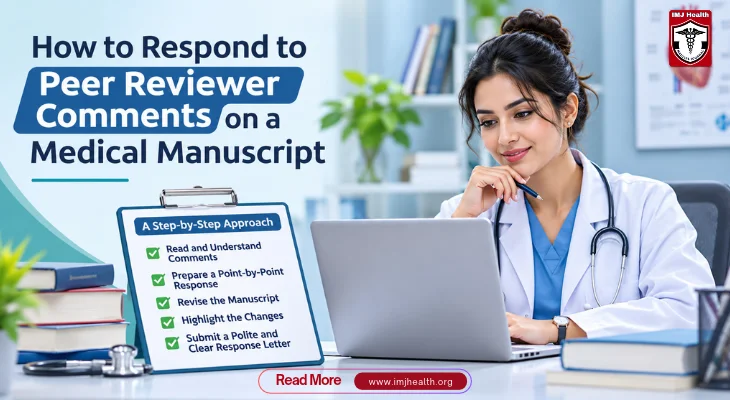
How to Respond to Peer Reviewer Comments on a Medical Manuscript: Complete Guide
Receiving peer reviewer comments is an important stage in medical research publishing. Reviewers may recommend major revisions, request additional analyses, identify weaknesses in the study design, suggest clearer explanations, or challenge the interpretation of results. Although these comments can sometimes feel difficult to address, they also provide an opportunity to improve the scientific quality, transparency, and readability of a manuscript.
A successful response requires more than correcting sentences or answering questions individually. Authors must understand the reviewer's concern, evaluate the scientific reasoning behind it, make appropriate revisions, and explain their decisions clearly. A professional response can help editors assess whether the authors have addressed the major issues raised during peer review.
This guide explains how to respond to peer reviewer comments on a medical manuscript, prepare a point-by-point response letter, manage disagreements, document revisions, and avoid common mistakes during resubmission. For related guidance on manuscript preparation, see How to Write the Materials and Methods Section of a Medical Research Paper.
Understanding the Peer Review Process in Medical Publishing
Peer review is a process through which independent experts evaluate a manuscript's scientific quality, relevance, methodology, interpretation, and reporting. In medical research, reviewers may also examine ethical considerations, patient safety implications, statistical methods, clinical relevance, and compliance with relevant reporting standards.
After reviewing a submission, the editor may issue one of several decisions:
- Accept: The manuscript is accepted, sometimes subject to minor editorial changes
- Minor revision: The authors must address limited concerns before a final decision
- Major revision: Substantial changes, clarification, or additional analyses are required
- Reject with an invitation to resubmit: The journal may allow a substantially revised manuscript to be submitted again under its policies
- Reject: The manuscript will not proceed toward publication at that journal
A revision decision does not guarantee acceptance. However, it gives authors an opportunity to demonstrate that they have carefully considered the reviewers' concerns and improved the manuscript where necessary.
The first step is to read the editor's decision letter and all reviewer reports carefully before beginning revisions. The editor may identify priority concerns or provide instructions that take precedence over individual reviewer suggestions.
Why a Structured Response to Reviewer Comments Matters
An effective response letter helps editors and reviewers understand exactly how the manuscript has changed and why particular recommendations were accepted, modified, or not followed.
A structured response can help authors:
- Address every reviewer comment without overlooking important issues
- Explain methodological and statistical decisions transparently
- Demonstrate that requested revisions have been incorporated into the manuscript
- Clarify misunderstandings about the study design, findings, or conclusions
- Maintain a professional relationship with the editorial team
- Reduce unnecessary back-and-forth during the revision process
The purpose is not to prove that every reviewer is wrong or to accept every suggestion automatically. Instead, authors should provide evidence-based responses that improve the manuscript while preserving the integrity of the research.
Step 1: Read the Editor's Decision and Reviewer Reports Carefully
Before editing the manuscript, read the complete decision letter and every reviewer comment. Reviewers may identify related problems in different sections, and a change made in one part of the manuscript may require adjustments elsewhere.
For example, a reviewer may question the definition of the primary outcome in the Methods section. Addressing that concern may also require changes to the Results section, tables, abstract, and discussion.
During the initial review, identify:
- Major methodological concerns
- Requests for additional statistical analyses
- Questions about sample size or participant selection
- Concerns about interpretation or clinical relevance
- Requests for additional references or comparisons with existing evidence
- Ethical, reporting, or data-transparency issues
- Language, formatting, and presentation corrections
Avoid drafting defensive responses immediately. First, establish what each reviewer is asking, why the concern matters, and what evidence or manuscript changes would address it.
Step 2: Organize Reviewer Comments Into a Revision Plan
Long reviewer reports can be difficult to manage without a systematic approach. Create a revision tracker to ensure that every comment receives a response.
A simple table can help organize the process.
Reviewer comment: Clarify participant selection. Required action: Expand eligibility criteria and recruitment details. Manuscript location: Methods. Status: Pending.
Reviewer comment: Explain missing data. Required action: Describe the extent of missingness and handling approach. Manuscript location: Methods and Results. Status: Pending.
Reviewer comment: Moderate a causal claim. Required action: Revise interpretation to reflect study design. Manuscript location: Discussion. Status: Pending.
Reviewer comment: Improve table presentation. Required action: Define abbreviations and clarify units. Manuscript location: Table 2. Status: Pending.
For complex reviews, add columns for the responsible co-author, statistical input, supporting evidence, and date completed.
Prioritize Comments by Importance
Not all comments require the same amount of work. A practical classification is:
Major scientific or methodological concerns: These may involve study design, selection bias, confounding, statistical validity, outcome definitions, or unsupported conclusions. Address them first.
Reporting and interpretation concerns: These include missing methodological details, unclear results, insufficient discussion of limitations, and gaps in the comparison with existing evidence.
Presentation concerns: These involve grammar, formatting, tables, figures, abbreviations, and readability.
This classification is a planning tool, not a reason to ignore minor comments. Every comment should still receive an appropriate response.

Step 3: Prepare a Point-by-Point Response Letter
A point-by-point response is generally the clearest way to answer reviewer feedback. Reproduce each comment, followed by the author's response and a description of the corresponding manuscript revision.
Use the reviewer's original wording accurately. If a comment contains several questions, separate them into individual points so that each issue can be addressed explicitly.
A standard structure is:
Reviewer 1, Comment 1: "The manuscript does not adequately explain how the study population was selected."
Response: "We thank the reviewer for highlighting the need for greater clarity regarding participant selection. We have expanded the Methods section to describe the recruitment setting, eligibility criteria, and participant selection process."
Revision made: "The relevant details have been added to the Methods section, under 'Study Population and Eligibility Criteria,' in the revised manuscript."
If the journal requests line numbers, include the relevant page and line numbers from the revised manuscript. Check these details after final formatting because line numbers may change during editing.
Use Clear Headings for Each Reviewer
For multiple reviewers, organize the document with headings such as:
- Response to the Editor
- Response to Reviewer 1
- Response to Reviewer 2
- Response to Reviewer 3
Use consistent formatting throughout the document. Depending on the journal's instructions, reviewer comments may be italicized or distinguished from author responses with labels or indentation.
Do not rely on color alone to communicate revisions, since the editor may print the document or view it without color formatting.
Step 4: Begin Each Response Professionally
A professional tone is important even when a reviewer's comments appear critical, repetitive, or based on a misunderstanding.
Useful opening phrases include:
- "We thank the reviewer for this helpful observation."
- "We appreciate the reviewer's suggestion and have revised the manuscript accordingly."
- "We agree that this point required clarification."
- "We appreciate the opportunity to explain our methodological approach."
- "We thank the reviewer for raising this important issue."
These expressions should be followed by a substantive answer. Repeatedly thanking the reviewer without explaining what was done does not resolve the concern.
Avoid language that sounds defensive or dismissive, such as "The reviewer clearly misunderstood the study" or "This comment is unnecessary." Instead, clarify the relevant information and explain the scientific reasoning behind the decision.
Step 5: Make the Necessary Changes to the Manuscript
A response letter should accurately describe revisions that are actually present in the manuscript. Do not write that a change has been made before incorporating it into the relevant section.
Depending on the comment, revisions may involve:
- Adding methodological details
- Clarifying eligibility criteria and recruitment procedures
- Providing further information about instruments, interventions, or outcome definitions
- Reporting statistical methods more completely
- Revising tables, figures, and supplementary files
- Correcting inconsistencies between the abstract, results, and discussion
- Adding appropriate limitations
- Rewriting claims that extend beyond the available evidence
- Improving the explanation of how findings compare with existing research
After each revision, review the surrounding text for consistency. A change to the primary outcome, for instance, may affect the abstract, statistical analysis plan description, results presentation, and conclusions.
Use Track Changes When Appropriate
Many journals request a marked-up manuscript showing the changes made during revision, together with a clean revised version.
When required:
- Enable Track Changes in your word-processing software before editing
- Make revisions directly in the manuscript
- Review tracked insertions and deletions for accidental or irrelevant changes
- Prepare a clean copy with the accepted revisions
- Ensure that both versions contain the same final text
Follow the journal's instructions regarding highlighting, line numbering, file naming, and supplementary materials.
Step 6: Respond to Requests for Additional Statistical Analysis
Statistical comments deserve particular attention because they may affect the validity or interpretation of the findings.
Reviewers may ask authors to justify the sample size, explain missing data, account for confounding, clarify model assumptions, report confidence intervals, or perform sensitivity analyses.
A strong response should explain what was done and why.
For example:
Reviewer comment: "The analysis does not appear to account for potential confounding variables."
Response: "We thank the reviewer for raising this concern. We have reassessed the analytical approach and added an adjusted analysis incorporating the prespecified covariates [list the actual variables]. The Methods section now describes the model specification, and the corresponding results are reported in Table [number]. The interpretation has also been revised to reflect the adjusted estimates."
Use this wording only if the additional analysis was genuinely performed.
When an Additional Analysis Is Not Appropriate
Not every requested analysis is scientifically justified or possible. The dataset may not contain the required variables, the sample may be too limited for a reliable analysis, or the proposed method may not suit the study design.
In such cases:
- Explain the specific limitation
- Describe the analyses that were performed
- Provide a methodological justification for the decision
- Add or strengthen the relevant limitations in the manuscript
- Consult a qualified statistician when necessary
Never invent analyses, alter results to satisfy a reviewer, or select statistical methods solely because they produce a more favorable outcome.
If an additional analysis changes the main findings, explain that change transparently and revise the abstract and conclusions accordingly.
Step 7: Handle Requests for Additional References
Reviewers may recommend references to improve the background, explain a methodological choice, or compare the findings with previous research.
Evaluate each suggested reference for relevance, quality, and accuracy. Add it when it genuinely strengthens the manuscript or addresses a meaningful gap.
A suitable response might be:
"We thank the reviewer for this recommendation. We have incorporated the suggested study into the Discussion section and explained how its findings compare with those of the present study."
If a suggested reference is not relevant, outdated, methodologically weak, or outside the scope of the manuscript, explain your reasoning respectfully.
For example:
"We appreciate the reviewer's suggestion. After reviewing the proposed reference, we concluded that its population and research question differ substantially from those of the present study. We have instead clarified the comparison with studies more directly relevant to our research question."
Do not add references merely to increase the reference count or create an impression of agreement with the reviewer. Every citation should support the point being made.
Step 8: Respond When You Disagree With a Reviewer
Authors do not have to accept every recommendation. Scientific disagreement is acceptable when it is handled objectively and supported by evidence.
Before rejecting a suggestion, consider whether the reviewer has identified a genuine weakness. A request may be inconvenient but still reveal a problem in the study's reporting or interpretation.
A well-reasoned disagreement should include three elements:
- Acknowledgment of the concern
- A clear scientific or methodological explanation
- A description of any alternative clarification or revision made
Example: Disagreement About Study Design
Reviewer comment: "The authors should use a randomized controlled trial design to establish the effectiveness of the intervention."
Response: "We appreciate the reviewer's observation. The present study was designed as an observational investigation to examine the association between [exposure] and [outcome]. A randomized controlled trial would address a different research question and was outside the scope of the current study. To avoid overstating the findings, we have revised the Discussion and Conclusion sections to clarify that the results demonstrate an association rather than establish causality. We have also expanded the limitations to acknowledge the implications of the study design."
This approach explains why the requested change is not appropriate while demonstrating that the underlying concern has been taken seriously.
Avoid Dismissive Responses
Do not write:
- "We disagree completely."
- "The reviewer is wrong."
- "This change is unnecessary."
- "The manuscript is already clear."
Instead, explain the reasoning and identify the relevant evidence or manuscript changes. If the reviewer's concern reveals ambiguity, improving the wording may be appropriate even when the authors disagree with the proposed solution.
Step 9: Address Conflicting Reviewer Recommendations
Occasionally, two reviewers offer contradictory recommendations. One may request a more detailed discussion, while another suggests shortening it. One may recommend an additional analysis, while another questions its appropriateness.
In these situations, consider the underlying purpose of each comment rather than following both literally.
A practical approach is to:
- Identify the shared concern, if one exists
- Review the editor's instructions
- Make a scientifically justified decision
- Explain how the revised manuscript addresses the issue
- Ask the editor for clarification when the conflicting recommendations cannot reasonably be reconciled
For example, if one reviewer requests additional discussion and another requests concision, authors may add a short, focused paragraph while removing repetitive material elsewhere.
If the conflict involves fundamental scientific interpretation, do not attempt to satisfy both reviewers through contradictory claims. Explain the rationale for the chosen approach in the response letter.
Step 10: Explain When a Requested Change Cannot Be Made
Sometimes a requested revision is not feasible because the relevant data were not collected, the necessary sample is unavailable, or the suggestion would require a new study.
A useful response should explain the limitation clearly and identify any alternative action.
For example:
"We appreciate the reviewer's suggestion to examine [specific variable]. However, this variable was not collected during the original study, and retrospective estimation would not be sufficiently reliable. We have clarified this limitation in the Discussion section and identified the question as an area for future research."
Do not imply that unavailable data have been obtained or that a new experiment was performed when neither occurred.
If the limitation substantially weakens the manuscript's central conclusions, authors should consider whether the findings need to be narrowed or whether the study can still support the claims being made.
Step 11: Review the Entire Manuscript After Making Revisions
Responding to individual comments can create inconsistencies if the manuscript is not reviewed as a complete document at the end.
For example, an updated statistical analysis may change the numerical results, while the original abstract still reports the earlier estimates. Similarly, a revised conclusion may no longer match the title or stated research objective.
Before resubmission, verify:
- The title, abstract, and main text are consistent
- All reported numbers match the final analyses and tables
- Table and figure references are correct
- Abbreviations are defined and used consistently
- New references appear in the reference list and are cited correctly
- Ethical statements remain accurate
- The response letter identifies the correct manuscript locations
- The clean and marked-up versions contain the same final revisions
- Supplementary files have been updated where necessary
Ask a co-author who was not responsible for a particular revision to review complex responses when possible. A fresh perspective can reveal unanswered questions or unclear explanations.
Step 12: Prepare the Final Resubmission Package
The final package depends on the journal's submission system and revision instructions. Commonly requested files include:
- A point-by-point response letter
- A clean revised manuscript
- A marked-up manuscript showing changes
- Revised tables, figures, or supplementary files, where applicable
- Updated declarations or forms requested by the journal
Check that the files are correctly named and uploaded to the appropriate fields. Confirm that the corresponding author has completed any required submission questions and declarations.
Submit the revision before the stated deadline. If additional time is genuinely needed, contact the editorial office before the deadline and request an extension with a brief explanation.
Common Mistakes to Avoid When Responding to Peer Review
1. Ignoring a Reviewer Comment
Every comment should receive a response, even if the requested change is not made. An unanswered comment can make the revision appear incomplete.
2. Providing Vague Responses
Statements such as "Corrected as suggested" or "The manuscript has been improved" do not explain what changed. Identify the revision, its purpose, and its location in the manuscript.
3. Changing the Manuscript Without Explaining Why
A reviewer should not have to search the entire manuscript to determine whether a concern has been addressed. Describe the change in the response letter and provide page or line numbers when required.
4. Arguing Without Scientific Evidence
Personal opinions and defensive language are less useful than evidence, methodological explanations, and transparent limitations.
5. Accepting Every Suggestion Without Evaluation
Some suggestions may be inappropriate for the study design or may introduce unsupported claims. Evaluate recommendations critically while remaining professional.
6. Making Unreported Changes to the Analysis
Any new analysis should be transparently described, and its results should be reported consistently. Do not conceal analytical changes or present exploratory findings as if they were prespecified.
7. Overlooking the Editor's Instructions
The editor may prioritize specific issues or request changes not explicitly mentioned by the reviewers. Address the editor's requirements as well as the individual reviewer comments.
8. Missing the Revision Deadline
Late submission can delay editorial processing and may jeopardize the opportunity to revise. Plan the work early and communicate with the journal if an extension is necessary.
A Practical Checklist Before Resubmitting a Revised Medical Manuscript
Use this checklist to assess whether your response package is complete.
- The editor's decision letter and all reviewer reports have been addressed
- Every reviewer comment has a corresponding response
- Responses are specific, respectful, and scientifically justified
- Each manuscript change has been made and verified
- Page and line numbers are accurate, where required
- Additional analyses are reported transparently
- Disagreements are explained with evidence or methodological reasoning
- Unavailable data and study limitations are acknowledged honestly
- The abstract, results, tables, figures, and conclusions are consistent
- New references and supplementary files are updated
- The clean and marked-up manuscripts are correct
- All required forms and declarations are complete
- The revised submission meets the journal's deadline and file requirements
Responding effectively to peer reviewer comments is an essential skill in medical research publishing. A well-structured, professional response can demonstrate that the authors have engaged thoughtfully with the reviewers' concerns and improved the manuscript accordingly.
The strongest responses combine respectful communication, transparent reporting of revisions, and evidence-based explanations for decisions. By preparing a systematic point-by-point response, making genuine improvements to the manuscript, and verifying consistency across all submission documents, authors can support an efficient revision process and strengthen the quality of their published work.
Remember that peer review is intended to improve scientific communication, not to serve as a personal critique. Authors who approach revisions as an opportunity to refine their work will be better positioned to navigate the process successfully. For those considering doctoral research in this area, Top 10 Pharmaceutical Research Topics for PhD offers guidance on selecting impactful research directions.
Continue Exploring Our Blog
- How to Write the Materials and Methods Section of a Medical Research Paper
- How to Write a Cover Letter for a Medical Research Journal: Complete Guide
- How to Write a Case Report for a Medical Journal: Structure and Requirements
- How to Prepare a Clinical Case Series for Journal Publication: Complete Guide
- Top 10 Pharmaceutical Research Topics for PhD