Systematic reviews and meta-analyses are essential methods for bringing together scientific evidence from multiple studies. They help researchers identify patterns in existing findings, assess the consistency of evidence, investigate differences between studies, and identify unanswered research questions. In medical and healthcare research, these methods can inform clinical practice, public health policy, research priorities, and evidence-based decision-making.
However, the reliability and usefulness of a systematic review depend partly on how transparently the researchers report their work. Readers need to understand how studies were identified, which eligibility criteria were applied, how the evidence was evaluated, and how the final conclusions were reached. Missing methodological details can make it difficult to judge the credibility of a review or reproduce its methods.
The Preferred Reporting Items for Systematic Reviews and Meta-Analyses (PRISMA) guideline provides a structured framework for reporting systematic reviews. Its current main guideline is the PRISMA 2020 Statement, which includes a 27-item checklist, an expanded checklist, an abstract checklist, and flow-diagram templates for new and updated reviews.
For researchers preparing manuscripts in 2026, understanding PRISMA 2020 is important for producing clear, complete, and publication-ready systematic reviews. This guide explains the checklist, its key reporting requirements, the PRISMA flow diagram, common mistakes, and practical steps for preparing a manuscript for journal submission.
What Is the PRISMA Checklist?
The PRISMA checklist is a reporting tool designed to help authors explain why a systematic review was conducted, what methods were used, and what the review found.
It supports transparent reporting across the major sections of a scientific manuscript, including the title, abstract, introduction, methods, results, discussion, and other essential information.
PRISMA is not a step-by-step method for conducting a systematic review. Instead, it guides researchers in reporting the work they have conducted. Authors still need appropriate methods for searching databases, screening studies, evaluating risk of bias, extracting data, and synthesising evidence.
The PRISMA 2020 framework includes four important resources:
- PRISMA 2020 checklist: A 27-item checklist covering the main reporting requirements
- Expanded checklist: Provides more detailed guidance on the individual items and sub-items
- PRISMA for Abstracts checklist: Helps authors report the essential information in a systematic review abstract
- PRISMA flow diagram: Illustrates how records and reports move through the identification, screening, eligibility, and inclusion stages
Researchers can access these resources through the official PRISMA 2020 website.
Why Is PRISMA Important for Systematic Reviews and Meta-Analyses?
A systematic review may involve hundreds or thousands of records, several screening stages, different study designs, and complex statistical analyses. Without transparent reporting, readers may struggle to determine whether the review methods were appropriate or whether the conclusions are supported by the evidence.
PRISMA addresses this challenge by helping researchers report their methods and findings in a consistent, understandable format.
1. Improves reporting transparency
The checklist reminds authors to explain the review question, eligibility criteria, information sources, search strategy, study selection process, and synthesis methods. This gives readers a clearer understanding of how the review was conducted.
2. Makes study selection easier to understand
The PRISMA flow diagram shows how many records were identified, screened, excluded, and ultimately included. It also helps authors explain why full-text reports were excluded.
This information makes the selection process easier to follow and helps readers identify possible gaps in reporting.
3. Supports critical appraisal
Readers need information about the methods used to assess the risk of bias in included studies and the limitations of the evidence. PRISMA encourages authors to report these details so that the review's findings can be interpreted appropriately.
However, completing the checklist does not automatically mean that a review is methodologically strong or free from bias.
4. Helps readers interpret meta-analysis findings
When a meta-analysis is performed, authors should report the statistical methods used, the results of individual studies, the pooled estimates where appropriate, and relevant measures of uncertainty.
Transparent reporting helps readers understand the magnitude and precision of the findings instead of relying solely on whether a result is statistically significant.
5. Facilitates peer review and publication
Editors and peer reviewers need to evaluate how the review was conducted and whether the conclusions follow from the evidence. A completed PRISMA checklist helps authors identify omissions before submission and can make manuscript assessment more efficient.
Journal requirements vary, so authors should always check the current instructions of their target journal.

Understanding the PRISMA 2020 Checklist
The PRISMA 2020 checklist contains 27 numbered items, some of which have sub-items. The items are organised into seven main sections.
Title: Identifying the report as a systematic review.
Abstract: Summarising the review's question, methods, results, and conclusions.
Introduction: Explaining the rationale and objectives.
Methods: Describing eligibility criteria, searches, selection, data collection, appraisal, and synthesis.
Results: Reporting study selection, study characteristics, risk of bias, and synthesis findings.
Discussion: Interpreting the findings and explaining limitations.
Other information: Reporting registration, protocol access, support, competing interests, and data availability.
Each section serves a distinct purpose in presenting a systematic review as a transparent scientific report.
1. Title and Abstract
Title
The title should clearly identify the work as a systematic review. It should accurately reflect the review question and, where appropriate, the population, intervention, exposure, outcome, or study designs being investigated.
For example, a title might describe a systematic review of the effectiveness of a particular intervention in adults with a specified condition. If a meta-analysis was conducted, the title may also indicate this.
Authors should avoid titles that imply a broader scope or stronger conclusion than the review supports.
Abstract
The abstract should provide a concise but informative summary of the review. PRISMA 2020 includes a dedicated checklist for systematic review abstracts.
Depending on the journal's format, the abstract should cover:
- The main objective or research question
- The inclusion and exclusion criteria
- The information sources and last search dates
- The methods used to assess risk of bias
- The methods used to present and synthesise results
- The number and characteristics of included studies
- The principal findings and their uncertainty
- The limitations of the available evidence
- The overall interpretation and relevant funding information, as applicable
Authors should ensure that the abstract agrees with the full manuscript. For example, the number of included studies and the reported pooled estimate should be consistent across the abstract, results section, tables, and figures.
2. Introduction: Rationale and Objectives
The introduction explains why the review is needed and what it aims to answer.
Rationale
Researchers should describe the current state of knowledge and identify the gap the review addresses. This may involve inconsistent findings across individual studies, a new body of evidence, uncertainty about intervention effectiveness, or the need to examine evidence across different populations.
The rationale should explain why a systematic review is appropriate rather than simply listing previously published studies.
Objectives
The review objectives should be explicit and sufficiently focused to guide the methods.
A structured question framework can help researchers define the scope. For intervention reviews, PICO is commonly used:
- P — Population: Who is being studied?
- I — Intervention: What treatment or intervention is being evaluated?
- C — Comparator: What is the intervention being compared with?
- O — Outcome: Which outcomes are being examined?
Other frameworks may be more appropriate for reviews of diagnostic accuracy, prognosis, prevalence, qualitative evidence, or other research questions.
For example, a review might ask whether a particular exercise intervention improves functional outcomes compared with usual care among adults with a chronic condition.
A clearly defined objective helps ensure that eligibility criteria, data extraction, and analysis methods remain aligned with the review question.
3. Methods: Eligibility Criteria and Search Strategy
The methods section should provide enough detail for readers to understand how the evidence was identified, selected, evaluated, and synthesised.
Eligibility criteria
Authors should specify the criteria used to determine which studies were eligible for inclusion. These may include population characteristics, interventions or exposures, comparators, outcomes, study designs, publication dates, language restrictions, and relevant settings.
Researchers should explain how studies were grouped for each synthesis, especially when the review includes different interventions, populations, or outcome definitions.
Eligibility criteria should be established before screening wherever possible. If they change during the review, authors should report the amendments and explain their reasons.
Information sources
Researchers should list all sources consulted to identify relevant evidence. Depending on the topic, these may include bibliographic databases, trial registries, websites, organisational resources, reference lists, and other relevant sources.
Examples of databases frequently used in medical research include PubMed/MEDLINE, Embase, and the Cochrane Library. The appropriate sources depend on the subject area and review question.
Authors should provide the date on which each source was last searched. This information matters because the available evidence may change over time.
Search strategy
The search strategy should be reported in sufficient detail for readers to understand how records were retrieved and, where feasible, reproduce the search.
Authors should provide the complete search strategies for each database, register, or website, including the search terms, Boolean operators, filters, and limits used.
For example, a search may combine terms related to a disease, a treatment, and a study design using AND and OR operators. The complete strategy should be reported rather than summarised only as a list of keywords.
A reproducible search strategy strengthens transparency and helps other researchers update or extend the review.
4. Study Selection and Data Collection
Study selection process
Authors should explain how records were screened and how full-text reports were assessed against the eligibility criteria.
The report should describe how many reviewers screened records and reports, whether they worked independently, and how disagreements were resolved. If automation tools were used to assist with screening, the methods should be described appropriately.
The distinction between a record, a report, and a study is important:
- A record is a database or other source entry that refers to a report
- A report is a document that provides information about a study
- A study is the underlying investigation, which may have multiple reports
One study can produce several reports. Counting every report as a separate study may lead to inaccurate totals or double-counting.
Data collection process
Authors should explain how information was extracted from the included reports, including the number of reviewers involved and whether data extraction was performed independently or checked by another reviewer.
The manuscript should also describe any methods used to contact study investigators for missing information or clarify ambiguous findings, where applicable.
Data items
Researchers should define the data they sought to collect. These may include participant characteristics, intervention details, study design, outcome definitions, follow-up periods, effect estimates, and information relevant to risk-of-bias assessments.
For outcome data, authors should explain how they selected results when a study reported several measures, time points, or analytical approaches. This is particularly important when multiple possible results could influence the conclusions.
5. Risk of Bias and Certainty of Evidence
Risk-of-bias assessment and certainty-of-evidence assessment address related but different questions.
Risk of bias in included studies
Risk of bias concerns the extent to which limitations in a study's design, conduct, or analysis may systematically distort its findings.
Authors should identify the tools or criteria used to assess risk of bias and explain how the assessments were performed. They should report the findings for the included studies and explain how those findings affected the interpretation or synthesis of the evidence.
The appropriate assessment tool depends on the study design and research question. Researchers should select a validated, suitable approach rather than applying one tool indiscriminately to every type of study.
Certainty or confidence in the body of evidence
The certainty of evidence concerns how confident readers can be in the overall findings for a particular outcome. It is not identical to the risk of bias of an individual study.
For example, an outcome may be supported by several studies but still have low certainty because of inconsistent results, imprecision, indirectness, or other limitations.
Authors should report the methods used to assess certainty or confidence in the evidence and present the results for relevant outcomes. If a framework such as GRADE is used, the authors should describe its application and explain the resulting judgements.
These assessments help prevent conclusions from being stronger than the available evidence justifies.
6. Data Synthesis and Meta-Analysis
Not every systematic review includes a meta-analysis. Whether statistical pooling is appropriate depends on the review question, the available data, and the comparability of the included studies.
Choosing a synthesis method
Researchers should explain how they decided which studies would contribute to each synthesis. Relevant considerations may include differences in populations, interventions, comparators, outcome definitions, study designs, and follow-up periods.
When statistical pooling is inappropriate, results may instead be presented using structured tables, descriptive summaries, or other suitable synthesis methods. The approach should be justified and reported transparently.
Statistical methods
For meta-analyses, authors should describe the statistical model and methods used to calculate pooled estimates. Depending on the analysis, relevant details may include effect measures, model assumptions, methods for assessing heterogeneity, and procedures for handling missing or transformed data.
Where appropriate, authors should report:
- The effect measure used, such as a risk ratio, odds ratio, mean difference, or standardised mean difference
- The statistical model used for pooling
- The methods used to assess variation between studies
- Any subgroup analyses or meta-regression
- Sensitivity analyses used to examine the robustness of findings
- The software used for statistical analysis
Researchers should not choose a synthesis method solely because it produces a statistically significant result. Analytical decisions should be scientifically justified and, where possible, specified in advance.
Heterogeneity
Heterogeneity refers to differences among study findings. These differences may arise from variations in participant characteristics, interventions, settings, outcome measurement, study methods, or chance.
When relevant, authors should report how heterogeneity was assessed and discuss possible explanations. A statistical measure alone may not explain why study results differ, so clinical and methodological considerations are also important.
Presenting meta-analysis results
Results should be reported clearly, with the pooled estimate and an appropriate measure of precision, such as a confidence interval. Authors should explain the direction and magnitude of the effect and avoid relying exclusively on p-values.
Forest plots can help readers examine individual study estimates alongside the overall pooled result. Other visualisations may be useful depending on the synthesis method.
When no meta-analysis is performed, authors should explain the alternative synthesis approach and present the findings in a structured, understandable way.
7. Results: Study Selection and Characteristics
The results section should describe what the review found, following the methods established in advance.
Study selection results
Authors should report the number of records identified, records removed before screening, records screened, reports sought and assessed, reports excluded, and studies included in the review.
The reasons for full-text exclusions should be explained where required by the checklist. The reported totals should agree with the PRISMA flow diagram.
Characteristics of included studies
A table is often the clearest way to summarise key study characteristics. Depending on the research question, these may include:
- Author and publication year
- Country or setting
- Study design
- Participant numbers and characteristics
- Intervention and comparator details
- Outcomes and follow-up periods
- Relevant methodological features
Authors should ensure that the table supports the review objectives and does not overwhelm readers with irrelevant information.
Risk-of-bias results
The findings of the risk-of-bias assessments should be presented in a clear format. Authors may use tables or figures to show judgements across studies and relevant domains.
The results should also be considered when interpreting the overall evidence, rather than being confined to a table that is never discussed.
8. Reporting the Main Findings and Limitations
The review's findings should be presented in a way that distinguishes observed results from interpretation.
Results of individual studies and syntheses
For each outcome or synthesis, authors should report the relevant findings, including the number of studies and participants contributing to the analysis where appropriate.
For meta-analyses, the pooled estimate should be accompanied by an appropriate measure of precision. If subgroup or sensitivity analyses were conducted, the results should be reported transparently.
Authors should also describe results that do not support the original expectations. Selectively reporting favourable findings can create a misleading impression of the evidence.
Limitations of the included evidence
The discussion should consider limitations in the underlying studies, such as high risk of bias, imprecision, inconsistent findings, or limited applicability to the target population.
These limitations should be distinguished from limitations of the review process itself.
Limitations of the review process
Review-level limitations may include restricted database coverage, language or publication restrictions, incomplete access to reports, missing data, or decisions that could have influenced study selection and synthesis.
Authors should explain the potential implications of these limitations rather than merely listing them.
Implications for practice and research
The conclusion should reflect the strength and limitations of the evidence. Authors should avoid making definitive clinical recommendations when the available evidence is uncertain or insufficient.
Where relevant, the discussion can identify unanswered questions, methodological gaps, and priorities for future research.
9. PRISMA Flow Diagram: What It Shows and How to Use It
The PRISMA flow diagram is a visual representation of the evidence-selection process. It helps readers follow the movement from identified records to the studies included in the final review.
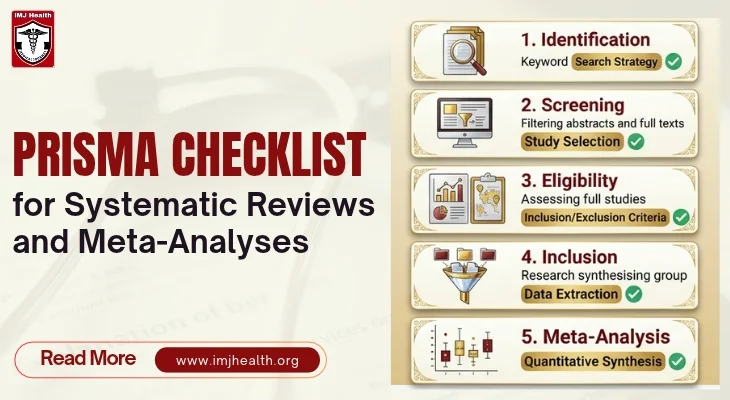
The diagram generally covers the following stages:
- Identification: Records found through databases, registers, and other sources
- Screening: Records assessed and excluded before full-text review
- Eligibility assessment: Reports retrieved and examined against the inclusion criteria
- Inclusion: Studies and reports retained for the review and, where relevant, synthesis
Authors should use the appropriate template for their review. The official PRISMA website provides different flow-diagram templates for new and updated reviews and for reviews that use databases and registers alone or additional sources.
The diagram should be completed using actual screening records. Researchers should not estimate counts or adjust totals simply to make the diagram appear consistent. If discrepancies are discovered, they should be resolved by checking the underlying records.
A well-prepared diagram helps readers understand the selection process, but it does not replace the detailed methods and results reported in the manuscript.
10. Registration, Protocols, Funding, and Data Availability
PRISMA 2020 includes a section for information that helps readers understand the planning, support, and accessibility of the review.
Registration and protocol
Authors should report whether the review was registered and provide the registry name and registration number, where applicable. They should also identify where the protocol can be accessed.
If the review was not registered, authors should state this accurately. Registration should never be claimed retrospectively as prospective registration.
Any important changes to the registered information or protocol should be described, including what changed and why.
Funding and support
The report should identify funding sources and other relevant support. Authors should explain the role of funders, where applicable, in the review's design, conduct, analysis, and reporting.
Competing interests
Relevant financial and non-financial competing interests should be disclosed in accordance with the journal's requirements.
Availability of data and materials
Authors should state whether and where data extraction forms, extracted data, analytical code, or other materials are available. Any access conditions or restrictions should be clearly explained.
Transparent reporting of these details supports scrutiny, reuse where permitted, and future updates to the review.
How to Apply the PRISMA Checklist Before Journal Submission
Using PRISMA early in manuscript preparation is generally more effective than completing it only after the paper has been written.
Step 1: Download the official checklist. Obtain the current PRISMA 2020 checklist from the official PRISMA website. Review the expanded checklist if you need more detailed explanations of individual items.
Step 2: Check the research question and protocol. Ensure that the objective, eligibility criteria, search methods, data collection procedures, and planned synthesis methods are described clearly. Compare the completed review with its protocol and record any important changes.
Step 3: Map each item to the manuscript. Identify where each checklist item is addressed in the main text, tables, figures, or supplementary files. The checklist should help locate the relevant information, not simply indicate that a topic has been mentioned.
Step 4: Verify search reproducibility. Check that the full search strategy for each source is available and that the last search date is reported accurately. Confirm that database names, search terms, filters, and limits are correctly documented.
Step 5: Reconcile the flow diagram and results. Check that the record, report, and study counts agree across the flow diagram, methods, results, and supplementary materials.
Step 6: Review the statistical reporting. Confirm that synthesis methods are explained and that effect estimates, confidence intervals, heterogeneity assessments, and sensitivity analyses are reported where relevant.
Step 7: Confirm transparency statements. Verify registration information, protocol availability, funding, competing interests, and data or materials availability.
Step 8: Follow journal-specific instructions. Check whether the journal requests a completed PRISMA checklist, a particular flow diagram, supplementary search strategies, or additional reporting documents. The target journal's current instructions take precedence where submission procedures differ.
Common Mistakes to Avoid When Using PRISMA
Even carefully prepared systematic reviews can have reporting gaps. The following mistakes are worth checking before submission.
Using an outdated checklist: PRISMA 2020 replaced the 2009 statement. Authors should consult the current official resources rather than automatically reusing an old checklist.
Providing incomplete search strategies: Listing databases without presenting the full search strategies can make the search difficult to evaluate or reproduce.
Failing to explain study selection: Authors should describe how screening was performed, how disagreements were resolved, and why relevant full-text reports were excluded.
Confusing reports with studies: Multiple publications may describe the same underlying study. These should be linked appropriately to avoid inaccurate counts or double-counting.
Omitting risk-of-bias findings: Describing the assessment tool without presenting the actual results leaves readers unable to evaluate the evidence properly.
Reporting only statistically significant findings: All relevant results should be reported transparently, including findings that are inconclusive or inconsistent with the original expectations.
Using a flow diagram with inconsistent totals: Participant or record counts should match the underlying review records and the manuscript's results.
Treating PRISMA as a quality score: Checklist completion is not proof that the review was well conducted. Reporting transparency and methodological quality are related but distinct.
Overstating conclusions: The discussion should account for study limitations, uncertainty, and the applicability of findings to the intended population.
PRISMA and Other Reporting Guidelines
PRISMA is not the only reporting guideline used in health and scientific research. The correct guideline depends on the type of study or evidence synthesis being reported.
PRISMA 2020: Systematic reviews and meta-analyses.
PRISMA-ScR: Scoping reviews.
PRISMA-P: Protocols for systematic reviews.
CONSORT: Randomized controlled trials.
STROBE: Observational studies.
STARD: Diagnostic accuracy studies.
CARE: Case reports.
SWiM: Reporting synthesis without meta-analysis in relevant intervention reviews.
These guidelines are not interchangeable. For example, CONSORT guides the reporting of an individual randomized controlled trial, while PRISMA guides the reporting of a systematic review that may include several trials or other eligible studies.
Researchers should also check whether a relevant PRISMA extension applies to their review question or synthesis method. The official PRISMA website provides information about extensions for different types and aspects of evidence synthesis.
Practical Example: Using PRISMA in a Medical Systematic Review
Imagine a research team wants to review the effectiveness of a rehabilitation intervention for adults recovering from a particular medical condition.
The team first defines its research question and eligibility criteria. It searches relevant databases and other appropriate sources, records the search dates, and saves the complete search strategies.
During screening, the researchers document the number of records found, remove duplicates, assess titles and abstracts, and examine full-text reports against the predefined criteria. They record reasons for excluding reports at the full-text stage and link multiple reports that describe the same study.
Next, the team extracts relevant study characteristics and outcome data, assesses risk of bias, and determines whether statistical pooling is appropriate. If a meta-analysis is performed, the researchers describe their statistical methods and report the pooled findings with appropriate measures of uncertainty.
The results section presents the included studies, risk-of-bias findings, and synthesis results. The PRISMA flow diagram summarises the selection process, while tables provide details about the included studies. The discussion explains the limitations of the evidence and the implications for practice and future research.
Finally, the authors complete the PRISMA checklist, verify that each item is addressed, and check the target journal's submission requirements.
This example illustrates how PRISMA can support transparent reporting throughout manuscript preparation. It does not replace the methodological expertise needed to design and conduct a reliable systematic review.
The PRISMA checklist provides an essential framework for reporting systematic reviews and meta-analyses transparently and completely. By following the PRISMA 2020 Statement, researchers can ensure that their manuscripts include the information readers, reviewers, and editors need to assess the validity and relevance of their findings.
From registration and protocol access to study selection, risk-of-bias assessment, synthesis methods, and data availability, PRISMA helps authors communicate their research in a structured and transparent manner. While following the guideline does not guarantee publication or prove methodological quality, it supports the production of more credible and useful evidence syntheses. For those considering doctoral research in this area, Top 10 Pharmaceutical Research Topics for PhD offers guidance on selecting impactful research directions.
Continue Exploring Our Blog
- CONSORT Guidelines for Reporting Randomized Controlled Trials: Complete Guide
- STROBE Checklist for Observational Studies: Medical Research Guide
- How to Write the Materials and Methods Section of a Medical Research Paper
- How to Report Clinical Study Results in a Medical Research Article
- Top 10 Pharmaceutical Research Topics for PhD