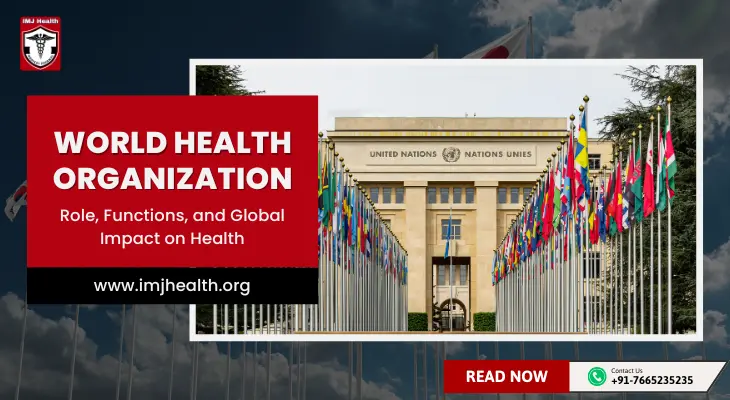
Founded on 7 April 1948, WHO is a specialized agency of the United Nations (UN). Its headquarters is in Geneva, Switzerland, and it currently has 194 member states. Over the years, WHO has helped control major diseases, supported health education, and encouraged countries to work together for better healthcare.
Role of the World Health Organization
The WHO acts as the global health leader. Its main role is to bring countries together to solve health problems that affect people worldwide. Some of its core responsibilities include:
- Setting International Health Standards
WHO develops guidelines, protocols, and recommendations that countries can follow to improve healthcare quality and safety. For example, it provides rules for vaccination schedules (future of vaccines), medical treatments, and disease prevention.
- Monitoring Global Health Trends
WHO collects and analyses health data from around the world. This helps to identify patterns, track disease outbreaks, and prepare for future health risks.
- Providing Technical Support
The organization offers training, expertise, and resources to countries that need help in improving their healthcare systems.
- Coordinating Emergency Responses
During health emergencies like pandemics, natural disasters, or outbreaks of deadly diseases, WHO helps organize international efforts to control the situation quickly.
- Promoting Health for All
WHO works to reduce health inequalities and ensure that everyone, regardless of their background or location, has access to essential healthcare services.
Functions of the World Health Organization
The WHO’s work is broad and covers almost every aspect of public health. Some of its key functions are:
- Disease Control and Prevention
It works to prevent and control diseases such as malaria, tuberculosis, HIV/AIDS, and polio. WHO also supports vaccination programs worldwide.
- Research and Knowledge Sharing
WHO supports medical research and shares important findings so that healthcare professionals across the world can learn and improve their practices.
- Health Policy Development
It helps governments create health policies that are effective, affordable, and sustainable.
- Setting Safety Standards for Medicines and Food
WHO ensures that medicines, vaccines, and even food products meet global safety and quality standards.
- Health Education
The organization develops educational campaigns to raise awareness about healthy lifestyles, nutrition, disease prevention, and sanitation.
Global Impact of the World Health Organization
The WHO has made a huge difference in global health over the past decades. Some examples of its impact include:
1. Eradication of Smallpox
Smallpox was one of the deadliest diseases in human history. In 1967, WHO launched a global vaccination campaign. By 1980, the world was declared smallpox-free — a success story often cited in public health history.
2. Polio Reduction
Polio once paralyzed hundreds of thousands of children each year. Thanks to mass immunization drives and surveillance, global polio cases have dropped by over 99%.
3. Fighting Pandemics
WHO has led responses to multiple pandemics, including bird flu, COVID-19, Ebola, and SARS.
4. Improved Access to Medicines
WHO works to negotiate lower drug prices and promote the use of quality-assured pharmaceuticals.
5. Promotion of Universal Health Coverage (UHC)
WHO supports governments in building affordable healthcare systems and ensuring equitable distribution of services.

Challenges Faced by WHO
Even though WHO has achieved many successes, it also faces challenges such as:
- Limited funding compared to the size of global health problems.
- Political pressure from member states.
- Difficulty in reaching remote or conflict-affected areas.
- Managing misinformation during health crises.