
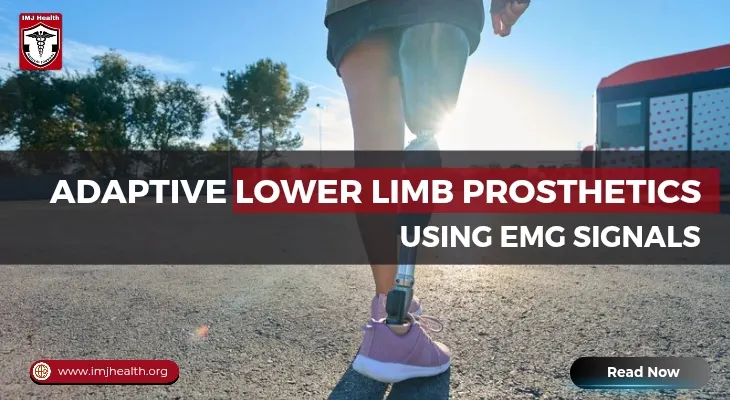
Adaptive lower limb prosthetics represent one of the greatest achievements in modern biomedical engineering and assistive robotics. Prosthetic control with the addition of electromyography (EMG) signals has transformed fixed prosthetic limbs into intelligent systems that can adjust their movement response to match human muscle activity. Modern prosthetic engineering is geared towards closing the difference between the biomechanical performance of natural limbs and artificial prostheses. Contemporary studies in neuroprosthetics, biomedical signal processing, biomechanics, and assistive robotics have proven EMG to be an effective interface for real-time prosthetic control. EMG-controlled adaptive prosthetic limbs read user intention and convert it into actionable mechanical response according to carefully designed algorithms and actuation techniques.
EMG-based adaptive prosthetics have captured the interest of many owing to the shortcomings of conventional prostheses. Traditional prosthetic limbs rely on passive or low-capacity myoelectric stimuli to generate binary motions or simple switch-based patterns. These systems cannot adapt to uneven terrains or gait changes. Application of EMG signals in the development of adaptive prostheses recreates near-natural gait because mechanical controllers align with neuromuscular activation patterns. This integration represents the convergence of several advanced fields: neural interfacing, movement physiology, machine learning, biomechanics, robotics, and rehabilitation science. For broader context on AI-driven assistive technologies, see The Role of Artificial Intelligence in Medical Research.
This article presents a detailed discussion of adaptive lower limb prosthetics that operate based on EMG signals. It investigates the theoretical basis, physiological principles, hardware architecture, computational mechanisms, actuation strategies, training protocols, and emerging technologies in this developing area. The targeted audience is postgraduate students and researchers, and the content is based on peer-reviewed literature and authoritative sources in neuroengineering, human motor control, rehabilitation robotics, and EMG signal processing.
Foundation of EMG Based Prosthetic Control
Origins of Electromyography in Prosthetic Science
EMG could be traced as early as the eighteenth century, although the use of EMG to control prostheses grew tremendously after the twentieth century due to developments in electrical measurement and signal capture. Early systems used surface electrodes to record action potentials of motor units, but signals were weak and easily distorted by noise. The development of differential amplifiers and improved electrode materials enabled better detection of muscle activity. The earliest myoelectric prosthetic systems appeared in the upper limbs, where EMG was used to trigger simple mechanical grippers. Lower limb applications developed later due to the complexity of gait control, which requires continuous graded information rather than discrete triggers.
Physiological Basis of EMG for Movement Control
EMG is the electrical representation of neuromuscular activity. Action potentials emitted when motor neurons fire propagate into muscle fibers. These discharges can be measured at the skin surface or by internal electrodes. Surface EMG records from multiple motor units, producing an interference pattern proportional to force output. EMG amplitude, frequency, and temporal features provide valuable information on the magnitude and timing of muscle activity.
In lower limb prosthetics, the significant target muscles include: Tibialis anterior, Gastrocnemius, Soleus, Quadriceps femoris, Hamstrings, Gluteus maximus and medius. These muscles contract in predictable patterns during walking, running, climbing, and balance activities. EMG-based prosthetics input these activation profiles into controllers that adjust the mechanical behaviour of the prosthetic limb.
Characteristics of EMG Signals Relevant to Prosthesis
EMG signals are non-stationary and stochastic. Their characteristics vary with fatigue, tissue impedance, structure, and electrode positioning. Despite these variations, EMG offers several benefits for prosthetic control. Major features include: Correlation of EMG with muscle strength, Temporal correlation with intention to act, Short latency reactivity, Usability in both dynamic and isometric tasks, and Interoperability with pattern recognition algorithms. The reliance of EMG on the human motor system renders it ideal for adaptive prosthetics that emulate natural gait.
Biomechanics of Lower Limb Movement
Understanding Human Gait
Human gait is a cyclical sequence of events incorporating stance phase and swing phase for each limb. Prosthetic control must replicate knee flexion and extension, ankle dorsiflexion and plantarflexion, hip movement, and joint transitions. Gait mechanics require intricate interrelations of muscles, ground reaction forces, proprioception, and the central nervous system. Any adaptive prosthetic must produce joint motion trajectories and torques similar to biological motion. The principles of human movement analysis connect to research in Mechanobiology of Disease Progression where mechanical forces shape biological outcomes.
Kinematic and Kinetic Considerations
Three main concerns in lower limb motion are: Angles and ranges of motion, Joint forces and power histories, and Ground contact patterns. Artificial limbs must support variable slopes, uneven surfaces, and rapid transitions. EMG control enables adaptive adjustment of mechanical output based on user-generated signals, rather than fixed programmed patterns. This minimizes delay between intention and action.
Neuromuscular Coordination
Neuromuscular coordination is essential for adaptive control. When a user wishes to walk faster, their muscle activity changes. Timing and amplitude of quadriceps and hamstrings shift accordingly. EMG-based systems detect these differences and modify prosthesis behaviour. Real-time adaptive behaviour depends on neuromuscular coordination as its foundation.
Hardware Architecture of Adaptive Prosthetics
EMG Signal Acquisition Systems
EMG signal acquisition involves electrodes, amplifiers, filters, and analog-to-digital converters. Surface electrodes are most popular due to their non-invasive nature. Silver-silver chloride electrodes with conductive gel are very common. Components include: Noise-reducing differential electrodes, High-gain low-noise amplifiers, Bandpass filtering (20-450 Hz), Notch filtering at 50/60 Hz to eliminate power line interference, and Digital conversion with sufficient sampling rate. Electrode placement must minimize cross-talk and maintain stable contact. The prosthetic socket should be designed with channels and insulation layers so that wires can pass without causing discomfort.
Actuation Systems in Lower Limb Prosthetics
Actuators produce joint movement in adaptive prosthetics. Typical options include: Electric motors with harmonic drives, Series elastic actuators, Pneumatic artificial muscles, and Hydraulic actuators. Series elastic actuators are popular due to their compliance, which increases shock absorption and safety. Electric motors can be controlled and integrated with embedded systems.
Embedded Systems and Computational Architecture
Microcontrollers and embedded processors control signal acquisition and run control algorithms. Requirements include: Real-time computation, Low power consumption, High reliability, and Fault tolerance. Common architectures include ARM-based microprocessors, field-programmable gate arrays (FPGAs), and digital signal processors (DSPs).

EMG Preprocessing and Feature Extraction
Challenges in Raw EMG Signals
Raw EMG is affected by motion artefacts and signal variation. Preprocessing is therefore essential. Key steps include: Detrending, Filtering, Rectification, and Smoothing.
Time Domain Feature Extraction
Time domain features are simplest and appropriate for low-power embedded systems. Common features include: Mean absolute value, Zero crossing rate, Slope sign changes, and Waveform length. These features correlate with muscle activation intensity.
Frequency Domain Feature Extraction
Frequency analysis employs Fourier-based methods. Common features include: Mean frequency, Median frequency, and Power spectral density. Frequency domain features can detect muscle fatigue and differentiate activation patterns.
Time Frequency Methods
Wavelet transforms provide both spectral and temporal data. Continuous wavelet transform and discrete wavelet transform enable detailed analysis of non-stationary signals. These techniques improve classifier performance by capturing transient behaviour.
Pattern Recognition in Prosthetic Control
Overview of Pattern Recognition Approaches
Pattern recognition aims to classify EMG signals into desired movement categories. Stages include: Preprocessing, Feature extraction, Feature selection, and Classification. Pattern recognition systems enable multi-degree-of-freedom control. The machine learning techniques used here parallel those discussed in Interpretable AI as a Clinical Requirement in Decision Support Systems.
Machine Learning Classifiers
Several classifiers have been studied for prosthetic control. Popular algorithms include: Linear discriminant analysis (LDA), Support vector machines (SVM), Artificial neural networks (ANN), k-nearest neighbours (k-NN), and Random forest models. Each classifier has trade-offs in training data requirements, computational load, and generalisation. LDA is simple and widely applied in embedded systems. Deep learning techniques like convolutional neural networks require extensive training data and computing resources.
Adaptive Control Strategies
Adaptive learning enables prosthetic systems to adjust parameters in response to changes in EMG patterns. This is essential because EMG varies with fatigue, mood, skin impedance, and electrode positioning. Adaptive algorithms include: Incremental learning, Online calibration, and Dynamic feature scaling. These methods ensure reliability over long-term use.
Control Architectures for Adaptive Prostheses
Proportional Control
Proportional control maps EMG amplitude to actuator torque or position. This approach is intuitive and enables smooth transitions. However, users must maintain constant effort, which can be tiring.
Pattern Recognition Based Control
This approach maps EMG patterns to discrete movement classes. It works strongly for upper limb control, but lower limb tasks require continuous modulation. Therefore, it is often combined with finite state machines.
Finite State Machine Based Control
The gait cycle can be modelled as discrete states, for example: Heel strike, Mid stance, Toe off, and Swing. EMG signals determine state transitions. Adaptive controllers modify thresholds and transition rules in real time.
Model Based Control
Biomechanical models estimate joint torques and angle trajectories. Model-based controllers estimate muscle forces using EMG, then use these estimates to control actuators. Commonly used models include Hill-type muscle models and neuromuscular models.
Hybrid Control Approaches
Multiple controllers are often combined to increase reliability. For example: EMG proportional control for fine tuning, Finite state machines for gait stage detection, and Model-based algorithms for torque estimation. These hybrid systems blend user intention, biomechanics, and environmental adaptation.
Integration with Sensory Feedback Systems
Types of Sensory Feedback
Lower limb prosthetics require sensory feedback to preserve balance and motor skills. Sensory inputs may include: Pressure sensors on the foot, Accelerometers and gyroscopes, Inertial measurement units (IMUs), and Torque sensors. Feedback enhances control by providing context for EMG-driven actions. Sensory integration in medical devices is also explored in Wearable Health Technology and Remote Patient Monitoring.
Reflex Inspired Control
Biological reflexes regulate joint stiffness and response to perturbations. Prosthetic systems simulate these reflexes by adjusting impedance based on ground reaction forces. EMG signals provide user intention, which is combined with reflex-inspired mechanisms.
Closed Loop Control
Closed-loop controllers compare actual performance with desired performance. Desired states derived from EMG are compared to actual states from sensors. Closed-loop systems are essential for adaptive behaviour, particularly on uneven terrain and during rapid movements.
Osseointegration and EMG Interfaces
Osseointegrated Prosthetic Interfaces
Osseointegration bonds the prosthetic to bone, enabling efficient load transfer and improved sensory feedback. In EMG systems, osseointegration enables intramuscular electrode placement and reduces motion artefacts.
Direct Muscle Interfaces
Implanted EMG electrodes, including intramuscular sensors and fine wire electrodes, offer higher signal quality. These interfaces enable advanced control techniques such as decomposition-based EMG analysis, which identifies individual motor unit behaviour.
Energy Systems and Power Management
Power Requirements of EMG Based Prosthetic Systems
Actuators, embedded processing, sensors, and data logging demand substantial power. Power-efficient computational architectures and efficient battery systems are required for daily use. Lithium-polymer cells remain popular due to their energy density.
Energy Regeneration
Some prosthetic designs incorporate regenerative braking to capture energy during gait phases with negative work. This saves power and improves overall efficiency.
Human Factors and User Adaptation
Cognitive Load in Prosthetic Use
Adaptive prosthetics should minimise cognitive load. EMG-based control requires less mental effort because users employ natural muscle activation patterns rather than consciously controlling mechanical stimuli. Training protocols further reduce cognitive demands by reinforcing intuitive control patterns.
User Training and Rehabilitation Protocols
Training includes: Calibration sessions, Gait training, Muscle strengthening, and Feedback-based learning. Users gradually learn to modulate EMG intensity and timing. Rehabilitation professionals contribute significantly to long-term adaptation. Rehabilitation strategies connect to broader discussions in The Reality of a PhD in Pharmaceuticals regarding the human factors in medical technology adoption.
Socket Comfort and Interface Stability
Secure socket fit affects electrode stability and signal quality. Design considerations include: Pressure distribution, Thermal regulation, and Material comfort. New liners and adjustable sockets improve usability and increase EMG signal consistency.
Advanced Technologies in EMG Driven Prosthetics
Machine Learning for Adaptive Calibration
Modern systems use machine learning to automatically tune parameters. Methods include online neural adaptation, reinforcement learning, and probabilistic modelling. These techniques personalize control systems according to user preferences and day-to-day variations.
Deep Learning Models
Deep learning enables end-to-end EMG interpretation. Convolutional networks, recurrent networks, and transformer networks learn latent features from raw EMG. Deep learning provides robust control despite noise or electrode movement.
Sensor Fusion Technologies
Sensor fusion combines EMG signals with inertial data, pressure sensors, and environmental sensors. This enhances stability by providing contextual awareness. For example, the torque profile needed for downhill walking differs from level walking; environmental cues can detect such differences.
Robotic Exoskeleton Integration
EMG-controlled prosthetics can be connected to lower limb exoskeletons to provide additional strength or rehabilitation support. Hybrid prosthetic-exoskeleton systems enable users to perform complex activities like running, lifting, and traversing rough terrain despite partial limb loss. This integration reflects trends in Digital Therapeutics and Remote Health where multiple technologies converge.
Clinical Outcomes and Performance Evaluation
Metrics for Evaluation
Clinical assessment includes: Gait symmetry, Energy expenditure, User comfort, Speed of adaptation, and Perturbation stability. Motion capture systems are used in biomechanical analysis to measure outcomes.
Case Studies and Clinical Trials
Research evidence shows that EMG-controlled prosthetics enhance walking stability, speed, and subjective comfort. Trials demonstrate lower metabolic cost during walking compared to passive prostheses.
Ethical and Social Considerations
Accessibility and Cost
Advanced prosthetic technologies are costly and often unavailable in low-income regions. Ethical frameworks emphasise equitable distribution of medical technologies. These equity concerns are also addressed in Top 10 Public Health Challenges in 2025.
Informed Consent and Surgical Risk
Implantable EMG interfaces require surgical procedures. Users must be fully informed about risks, benefits, and maintenance requirements.
Long Term Reliability
Mechanical failure and sensor degradation remain concerns. Prosthetic design should prioritise safety and durability for long-term use.
Future Directions of EMG Controlled Prosthetics
Neural Decoding and Advanced Interfaces
Future systems may combine EMG with peripheral nerve interfaces. Neural electrodes can record signals more directly, enabling finer control. These advances parallel work in Neuroscience and Brain Health Research where neural interfaces are transforming our understanding of brain-body connections.
Biohybrid Systems
Biohybrid technologies combine living muscle tissues with artificial structures. Tissue engineering research could produce actuators that contract similarly to biological muscles.
Fully Autonomous Prosthetic Control
AI-powered prosthetics could predict user intention without requiring explicit EMG patterns. Predictive models could adjust torque and stiffness in anticipation of unpredictable events.
Integration with Digital Health Ecosystems
Cloud connectivity, data logging, and remote monitoring would enable clinicians to customize prosthetic settings and track long-term trends.
EMG-based adaptive lower limb prosthetics represent a radical development in prosthetic technology. They mediate the relationship between human neuromuscular intention and mechanical performance by converting muscle activity into purposeful movement. EMG-driven systems address the shortcomings of traditional passive or switch-operated prosthetics by offering real-time adaptive behaviour that replicates natural gait. The effectiveness of these devices lies in the integration of biomechanics, biomedical signal processing, embedded systems, machine learning, and human factors engineering.
The prosthetic limb becomes an extension of the user by interpreting muscle activity patterns and converting them into control signals that drive actuators similar to human operation. Contemporary prosthetic designs integrate hybrid control schemes, sensor fusion, and adaptive learning, enhancing reliability across various settings. Rehabilitation programmes help users interact with the system intuitively, reducing cognitive burden and enabling naturalistic action.
The combination of sensory feedback, reflex-inspired control, and closed-loop systems ensures that EMG-based prosthetics do not act as discrete mechanical devices but as biomechanical systems responsive to user intent and environmental changes. These systems can adapt to slopes, level walking, stairs, or perturbations in real time according to the user's neuromuscular signals.
The field continues to advance through neural interfaces, deep learning, robotics, and osseointegration. Ongoing research aims to improve electrode stability, boost signal quality, minimise noise, create stronger actuators, and develop algorithms more responsive to the non-stationary nature of EMG. Future prosthetic technologies will be marked by long-term reliability, durability, and equitable access. For researchers considering doctoral work in this area, Top 10 Pharmaceutical Research Topics for PhD offers guidance on selecting impactful research directions.
As science progresses, EMG-driven adaptive prosthetics will develop into more natural, efficient, and personalised motion systems. The vision of prosthetic engineering encompasses smart limbs that readily integrate with the human body, recognise neural intent signals, and respond with controlled coordinated movement. These innovations will bring improved quality of life, autonomy, and mobility to lower-limb amputees.